

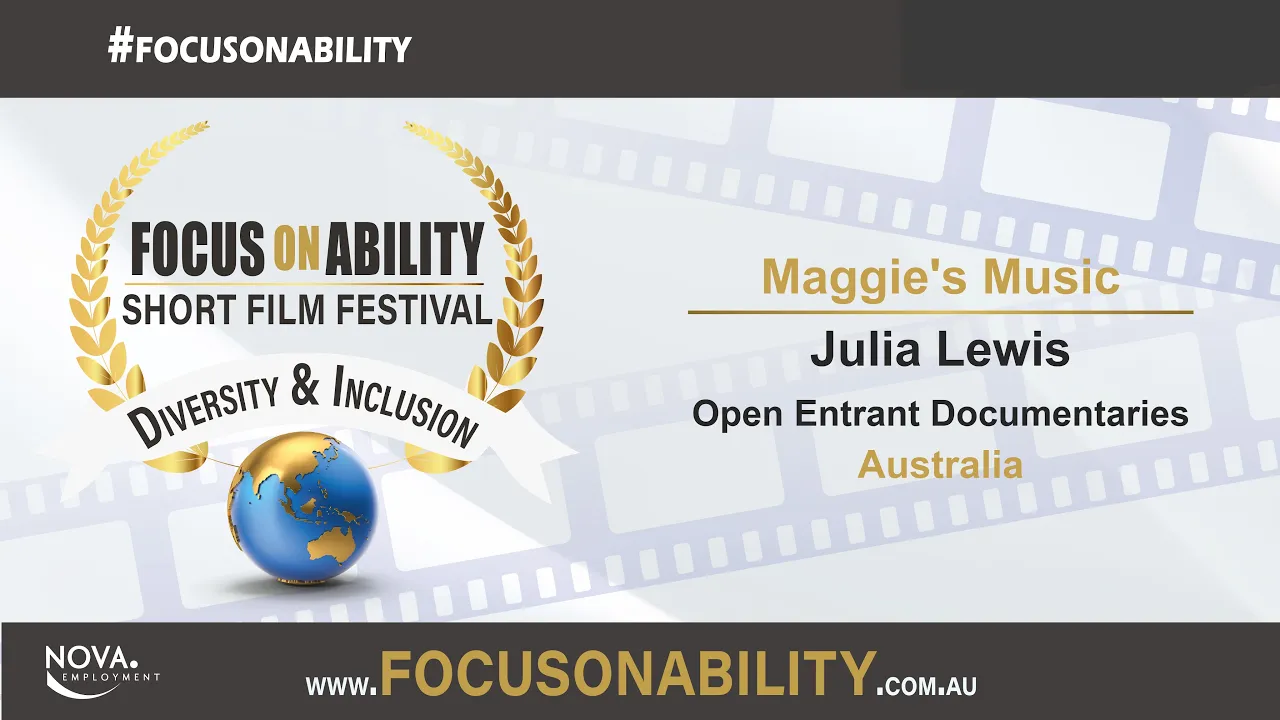
About this Short Film
Maggie’s Music is a short documentary about Dr Maggie Bell, a composer living with Dissociative Identity Disorder (DID), formerly known as Multiple Personality Disorder. DID can deeply affect daily life through social anxiety, depression, isolation, suicidal thoughts, intrusive memories, amnesia, and distressing switches between different parts or alters. For Maggie, DID developed in response to childhood trauma and shaped much of her inner and outer world for many years, including long periods of withdrawal. Her life began to shift when she discovered that music composition could become a powerful way for her 62 parts to communicate. Through “composition by alters, ” Maggie found a creative process that gives voice to non-verbal parts, strengthens connection within herself and with others, and offers focused time away from distressing thoughts, feelings, and images. As she composes, Maggie is able to gain perspective, lift her mood, and help her parts feel heard and understood. Maggie’s Music presents a story of resilience, creativity, and purpose, showing how music not only supports Maggie’s own healing but also helps others understand DID with greater compassion, dignity, and hope.
In the filmmaker's words
Maggie’s Music was inspired by the extraordinary story of Dr Maggie Bell and her courageous journey living with
Dissociative Identity Disorder (DID). Developed as a collaborative effort with Dr Maggie Bell, co-producer Dr Chris
Willems, and clinical psychologist Dr Jan Ewing, the film explores how music composition became both a creative
language and a pathway toward healing complex trauma.
My intention with this documentary is to challenge stigma surrounding DID by presenting Maggie’s experience not
through fear or sensationalism, but through compassion, intelligence, artistry, and humanity. This five-minute
festival version focuses on the emotional connection between identity, memory, and music, while inviting
audiences to reflect on the resilience of the human spirit, the importance of being heard and understood, and the
power of creativity to transform pain into meaningful expression.
— Julia Lewis
Film Details
Film Transcript
I became very withdrawn and finally decided I needed psychological help. Thank goodness I did pursue that, and after four people I found my current psychologist who has been very supportive and knowledgeable.
It is like you're in the middle of a party of 100 or 200 people and you're standing in the middle of the room and you've got everybody around you talking, shouting, screaming, laughing, crying, and that can be going on in my head at one time. I was hardly going out of the house at all. So she encouraged me to go to a concert at the ABC Concert Hall with the Beethoven septet. It was wonderful and a real eye-opener. What I heard there were the seven different instruments playing in my mind at the same time independently. I decided I wanted to explore the possibility of me having different personalities.
So I started writing an orchestral piece and, unbeknownst to each of the parts, they each chose an instrument and they were writing their own and composing their own independent part. It was the most overwhelming experience to have at the end of that—wow, some of this actually sounds nice—and the others had no idea that they were actually working in tandem with other personalities and instruments.
And so postcon we made this watershed move into then exploring whether or not she could also compose independently, which then meant that they started to cooperate with each other and know about each other. And so the phobia started to really reduce and the compassion, cooperation and communication increased. But they are fairly stubborn, strong-willed, and it was them who was trying to portray through the music how intense the feelings were.
We compose. So we get to the music, we get to the page, and what comes out is literally what's going on in my mind, and they will actually give themselves a name. Some of the personalities are non-verbal. So this process of composition has been an absolute godsend for them because it's the first time they've ever had a voice.
Specifically doing the PhD because I've had to delve so much into the personalities from the creative side. Jen and I both feel we've probably done more work in the last 3 years than the previous 15 years. It's actually been quite incredible. I'm very, very blessed that my psychologist has been on board with this and she has encouraged me to take this journey.
We've had parts working together that have never worked together before, or there's been some integration of parts that are the same part at different ages. Previously they were aware that they were the same parts at different ages but had no connection with each other, and they've now integrated—she describes it like a matrioska doll; they're all within the one part now.
This is really what I want to do: to help people, whether it is just listening, you know, but I think more than that I want to get them into their own creative paths, cuz I think creativity is the most wonderful tool for mental health issues.
Filmmaker
Julia Lewis is the filmmaker behind this entry. See every Focus on Ability entry from Julia Lewis.

Want to hear how the festival goes?
We will email you when voting closes and the winners are announced. Nothing else, and you can stop any time.